Most visitors experience Dhaka through its streets. They remember the rickshaws, the traffic, the crowded markets, the calls from shopkeepers, and the energy that seems to follow the city from morning until late at night. Dhaka can be overwhelming, but that intensity is also part of what makes it memorable.
Yet some of the most interesting cultural experiences near the capital are found away from the city’s busiest neighborhoods.
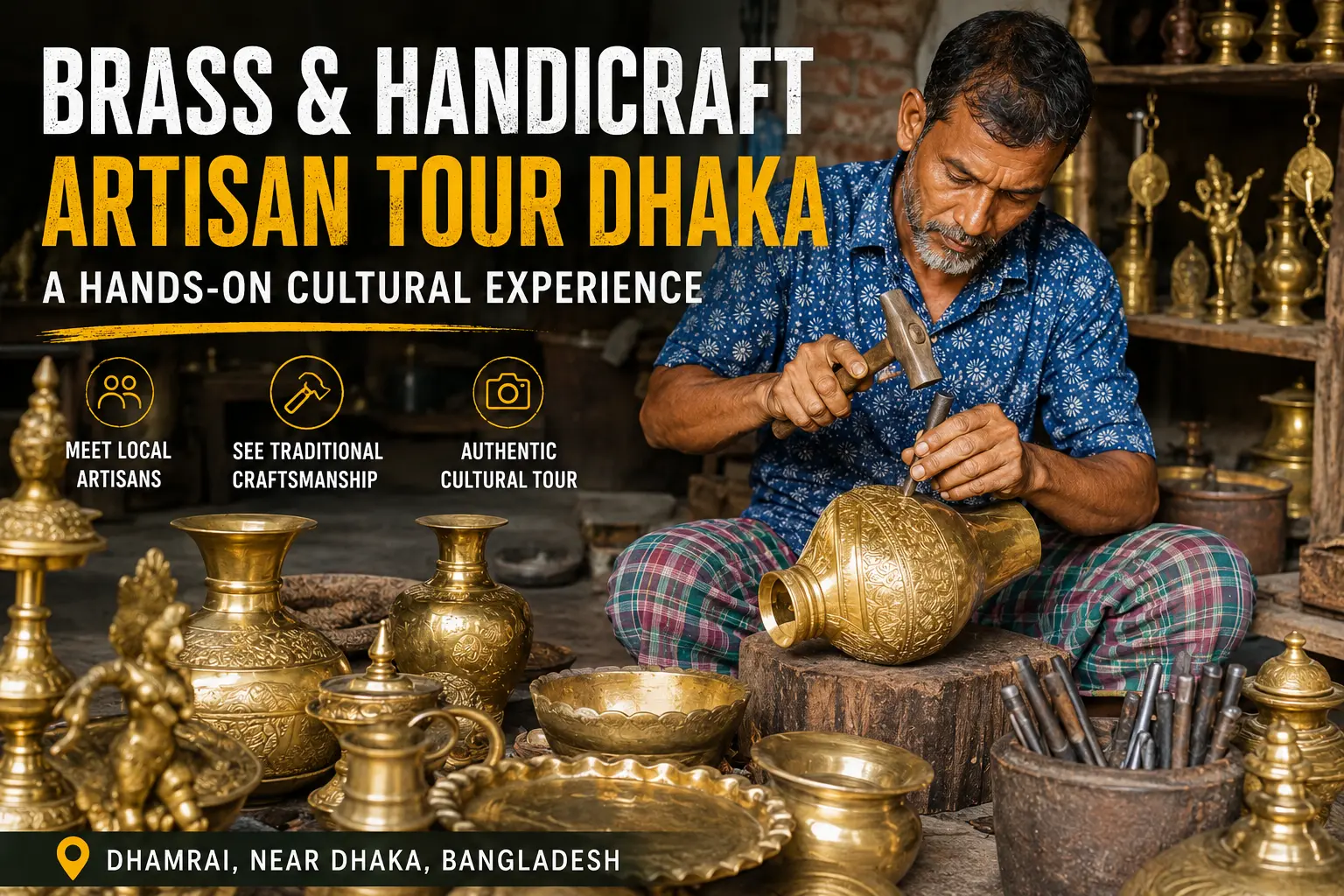
Travel toward Dhamrai, and the pace begins to change. Workshops replace office buildings. The sounds are different too. Instead of traffic and horns, you may hear metal being hammered, tools moving across a workbench, or artisans discussing the next stage of a piece they have been working on for days.
This is where a brass artisans tour Dhaka becomes more than a simple day trip.
It gives you the chance to see a traditional craft in the place where it is still practiced.
Dhamrai has long been associated with bronze, brass, copper, and bell-metal craftsmanship. The area’s artisans have produced everything from household utensils and decorative pieces to religious sculptures and ceremonial objects. Traditional metalworking remains an important part of the region’s cultural heritage, although the number of workshops and craftspeople has declined significantly over time.
For travelers who want to see something beyond the usual sightseeing route, this experience offers a closer look at the people behind Bangladesh’s traditional handicrafts.
You are not standing behind a glass case looking at an object from the past.
You are visiting a place where the work is still being done.
You can see the materials.
You can watch the process.
And, depending on the workshop and tour arrangement, you may have the opportunity to meet the artisans whose skills have been shaped by years of experience.
For anyone interested in culture, craftsmanship, photography, design, or the everyday life of Bangladesh, a brass artisans tour in Dhaka can become one of the most memorable experiences of the trip.
Why Visit Brass Artisans Near Dhaka?
Travel can sometimes make every destination feel the same.
A famous building is photographed.
A market is visited.
A meal is eaten.
Then it is time to move on.
There is nothing wrong with seeing major attractions, but some experiences stay with you because they allow you to understand how people live rather than simply showing you where they live.
That is the appeal of visiting artisans.
A traditional workshop does not need to be polished or designed for tourists to be interesting. In fact, the opposite is often true. The worn tools, unfinished objects, worktables, molds, and stacks of raw materials are part of what make the place feel genuine.
You begin to notice the amount of work behind an object that might otherwise look simple.
A brass bowl on a shop shelf is just a bowl until you understand how much labor, knowledge, and physical effort went into making it.
A sculpture becomes more interesting when you learn that its shape first existed as a wax model.
A decorative piece becomes something more personal when you have watched an artisan refine its surface by hand.
That connection between the maker and the finished object is what makes this type of cultural experience worthwhile.
It also offers a different introduction to Bangladesh.
If an Old Dhaka Tour helps you understand the history, architecture, food, and everyday movement of the capital, a visit to Dhamrai introduces you to a quieter but equally important side of the country: the communities where traditional knowledge is still carried through practical work.
Dhamrai: One of Bangladesh’s Traditional Centers of Metal Craft
Dhamrai is located northwest of Dhaka and has been closely connected with traditional metal craftsmanship for generations.
The area is particularly known for brass, bronze, copper, and bell-metal work. Bangladesh’s Cultural Heritage Inventory identifies traditional metal crafts in Dhamrai as an important living heritage and documents the use of techniques including lost-wax casting, clay casting, sand casting, hammering, molding, metal melting, and finishing.
For visitors, this matters because Dhamrai is not simply a place where crafts are sold.
It is a place where the process itself is part of the experience.
The craft has historically supported families and communities in the region. Metal objects made here have included practical household items, religious pieces, decorative objects, lamps, bowls, plates, bells, figurines, and other handicrafts.
Like many traditional industries, however, the craft has faced difficult changes.
Cheaper factory-made alternatives, changing consumer habits, rising material costs, and fewer young people entering the profession have all affected the industry. Recent reporting from Dhamrai has highlighted the shrinking number of workshops and the pressure facing artisans who continue to work with brass and bell metal.
That context gives the visit greater meaning.
You are not just watching an old technique because it looks interesting.
You are seeing a living tradition that is trying to survive in a very different economic world.
What Makes a Brass Artisan Tour Different?
The best cultural experiences do not feel like performances.
You should not feel as though people have stopped their normal work just so visitors can take photographs for ten minutes before moving on.
A good artisan visit allows you to spend time in the environment where the craft actually happens.
There may be several people working on different stages of production.
One person might be preparing a model while another is finishing a piece that has already been cast. You may see objects that are almost complete sitting beside pieces that have only just begun.
The process is rarely as straightforward as it looks from the outside.
That is one reason why a guided experience can be particularly useful.
Without explanation, a traveler might see clay molds, wax, metal fragments, and unfamiliar tools without understanding how they are connected.
With the right context, the workshop begins to make sense.
You can follow the journey of an object from an initial design through molding, casting, cooling, cleaning, and finishing.
For many visitors, that is the point when the experience becomes genuinely interesting.
The finished brass object is no longer the main attraction.
The craftsmanship behind it is.
Meet the Artisans Behind Bangladesh’s Metal Crafts
There is a tendency in travel writing to romanticize traditional craftspeople.
That can make the people behind a craft sound like characters from another era rather than skilled professionals working in the present day.
The reality is more interesting.
The artisans of Dhamrai are craftsmen who understand their materials through experience. Their work requires precision, patience, and a familiarity with processes that cannot be learned overnight.
Metal does not always behave exactly as expected.
A mold can fail.
A surface may require more finishing than planned.
A small detail can affect the appearance of the final piece.
Years of experience help an artisan recognize these problems and respond to them.
That is what makes watching the work so fascinating.
You may not understand every technical step, but you can see the confidence with which an experienced craftsperson approaches the material.
There is usually very little wasted movement.
The tools are familiar.
The sequence is understood.
The hands know what to do before the visitor has even had time to work out what is happening.
A respectful conversation can also reveal the human side of the craft.
Some artisans have spent decades in the profession. Others have learned through family connections or long periods of apprenticeship. The stories vary from workshop to workshop, which is why it is better to approach the experience with curiosity rather than expecting one fixed narrative.
Ask questions.
Listen to the answers.
And give the artisans time to explain their work in their own way.
How Traditional Brass Crafts Are Made
One of the most fascinating parts of a brass artisan tour Bangladesh experience is understanding how many stages are involved before a finished object is ready.
The exact process can vary depending on the size, shape, and type of object being made. Dhamrai artisans are associated with several traditional handmade techniques, including lost-wax casting, clay casting, sand casting, and hammering.
Among these methods, lost-wax casting is particularly interesting for visitors because it makes the transformation from an idea into a finished metal object easier to follow.
Creating the Original Form
The process can begin with a model.
For detailed sculptures and decorative pieces, wax may be shaped into the form the artisan wants to reproduce.
At this stage, the object already needs careful attention.
The shape, proportions, and smaller details matter because they will influence everything that follows.
Visitors often find this part surprising because the wax model can look almost like a finished piece of artwork on its own.
But it is only the beginning.
The wax is not the final material.
It is part of the process that will eventually allow the metal to take its place.
Building the Mold
Once the model is ready, it is covered with layers of material to create a mold.
This stage requires care because the mold needs to capture the details of the original design.
The object is gradually prepared for heating.
The wax will eventually melt away, leaving the empty space where molten metal can later be poured.
That is where the name “lost-wax” comes from.
The wax model disappears during the process, but its shape remains inside the mold.
Pouring the Metal
This is one of the stages that often attracts the most attention during a workshop visit.
Molten metal is carefully poured into the prepared mold.
There is heat, weight, timing, and risk involved, which is why visitors should always remain where the artisans or guide instruct them to stand.
Once the metal has cooled and solidified, the piece begins to emerge from the process that started with a completely different material.
The transformation is remarkable.
Something that began as an idea and then existed as wax now has a permanent form in metal.
Finishing the Piece
Casting does not mean the work is finished.
The newly formed object may need to be cleaned, polished, refined, or adjusted.
Edges may require attention.
Surfaces may need to be smoothed.
Small details may be improved by hand.
This final stage can be just as important as the casting itself.
It is often where the individual skill of the artisan becomes most visible.
A good visit should allow you to see more than one stage if possible.
Watching only the final polishing process can be interesting, but seeing how the different stages connect gives you a much stronger understanding of traditional metal craftsmanship.
More Than Brass: The Range of Traditional Handicrafts
When people hear the phrase “brass craft,” they sometimes imagine only decorative statues or souvenir items.
The tradition is much broader than that.
Dhamrai’s metalworking heritage includes practical objects, decorative pieces, religious items, household utensils, bells, lamps, bowls, plates, containers, figurines, and other handmade products. The exact range varies between workshops and individual artisans.
This variety tells an important story about the role metal crafts have played in Bangladeshi life.
Historically, handmade metal objects were not limited to collectors or tourists.
Many were part of everyday households and religious practices.
Changing consumer habits have altered that relationship, but the skills behind the work remain.
Today, visitors may see a mixture of traditional designs and products created for modern decorative markets.
That evolution is worth paying attention to.
Traditional craftsmanship does not always survive by remaining completely unchanged.
Artisans often adapt to new buyers, new tastes, and new opportunities while continuing to use skills that have been passed down over generations.
A Hands-On Cultural Experience Near Dhaka
A brass artisans tour Dhaka is best suited to travelers who enjoy seeing how things are made.
It is not the kind of experience where you arrive, take a few photographs, and immediately move to the next attraction.
The more time you spend understanding the work, the more rewarding the visit becomes.
Depending on the tour arrangement, you may have the opportunity to:
- Visit a working traditional metal workshop
- Watch artisans at different stages of production
- Learn about lost-wax casting and other handmade techniques
- See traditional tools and molds
- Meet local craftspeople
- Ask questions about the history of the craft
- Photograph the workshop and working process with permission
- Explore other cultural locations around Dhamrai
- Purchase locally made handicrafts where available
Many existing Dhamrai day tours combine brass artisans with pottery villages and other stops around Savar and the outskirts of Dhaka.
That combination can work well for travelers who have a full day available.
However, there is also value in giving the brass artisans enough time.
Trying to fit too many attractions into one day can turn a cultural experience into a checklist.
If meeting artisans and understanding traditional crafts is your main interest, make sure the itinerary allows time for it.
Combine Brass Artisans With Bangladesh’s Other Cultural Experiences
One of the advantages of staying in Dhaka is that you can explore several very different aspects of Bangladesh without immediately taking a domestic flight or a long-distance journey.
A visit to Dhamrai can be followed by a completely different experience in the capital.
Spend a day on an Old Dhaka Tour, and you may find yourself walking through narrow historic streets, exploring markets, seeing Mughal-era architecture, and experiencing some of the city’s most distinctive food traditions.
Choose a Dhaka Food Tour, and the focus shifts again.
This time, Bangladesh is understood through its kitchens, street food, historic restaurants, spices, and regional flavors.
A brass artisan experience offers another perspective.
Here, culture is expressed through work.
Through materials.
Through techniques that have survived because people continue to practice them.
For travelers building a longer itinerary, these experiences can create a more complete picture of Bangladesh than visiting landmarks alone.
Is a Brass Artisan Tour Good for Photography?
Absolutely, but it is important to approach photography with some patience.
Traditional workshops can be visually rich.
The textures of metal, clay, wax, old tools, fire, and unfinished objects create interesting details. The people at work are equally compelling, particularly when you focus on the relationship between the artisan and the material rather than simply taking posed portraits.
The best photographs often come after you have spent some time in the workshop.
Watch how people move.
Notice where the natural light enters.
Look for the small details that tell the story of the place.
A pair of hands holding a tool may say more than a wide photograph of the entire workshop.
At the same time, respect matters.
Always ask before taking close portraits.
Do not stand in the way of someone who is working.
Avoid interrupting a difficult stage of the process just to get a better angle.
If photography is a major reason for your visit, you may also enjoy a Street Photography Tour in Dhaka. The city and the artisan workshop offer completely different photographic environments, which makes them an interesting combination for photographers visiting Bangladesh.
Can You Buy Handicrafts Directly From Artisans?
In some workshops, visitors may have an opportunity to purchase handmade items directly from the artisans or from local sellers.
This can be one of the more meaningful ways to take home a souvenir.
Instead of buying an object from a generic shop, you may be able to choose something connected to a place you have visited and a process you have actually seen.
Before buying, consider the practical side.
Brass and other metals can be heavy.
Large decorative pieces may be difficult to pack.
Fragile items may require additional protection.
For visitors returning to the United States or traveling onward through several countries, smaller items are usually easier to manage.
It is also a good idea to ask about the material and care requirements, particularly if you are purchasing something valuable.
The best souvenir does not need to be expensive.
A small handmade object can carry a stronger memory than something large if you know who made it and understand the work behind it.
How Far Is Dhamrai From Dhaka?
Dhamrai is located to the northwest of Dhaka. Heritage documentation places traditional craft communities in the area at roughly 39 to 40 kilometers from the capital, although actual driving distance and travel time depend on your starting point and route.
Traffic is one of the biggest factors when planning the day.
A distance that appears short on a map can take much longer than expected, particularly when leaving Dhaka or returning during busy hours.
For that reason, it is best not to plan the experience too tightly.
Start early.
Allow extra time for the road.
And avoid scheduling an important flight or appointment immediately after the tour.
For international visitors unfamiliar with local transportation, arranging a private vehicle and guide can make the experience considerably easier.
What to Expect During the Day
Every itinerary is different, but a brass and handicraft experience usually works best as a substantial part of a day trip.
You can expect to leave Dhaka in the morning and travel toward Dhamrai.
Once there, the focus should be on the artisan community and the traditional metalworking process.
Depending on your itinerary, the day may also include another cultural or rural experience.
Some established tour routes combine the brass workshops with pottery villages, river travel, or the National Martyrs’ Memorial in Savar.
If you are booking a private experience, it is worth asking exactly how much time is allocated to the artisan visit.
That matters.
A ten-minute stop at a workshop and a meaningful visit are not the same thing.
Ask whether you can meet the artisans.
Ask whether photography is permitted.
Ask if there is an opportunity to understand the different stages of production.
The answers will help you choose an experience that matches your interests.
When Is the Best Time to Take a Brass Artisan Tour?
The workshops and craft communities can be visited during different times of the year, but weather affects how comfortable the overall day will be.
For many international travelers, the cooler and generally drier months between late autumn and early spring are especially pleasant for exploring Dhaka and taking day trips into the surrounding countryside.
The hotter and wetter months can still offer rewarding experiences, although travel conditions may be more demanding.
The more important consideration is planning around your own Bangladesh itinerary.
If you are spending several days in Dhaka, the artisan tour can provide a welcome contrast to the city’s intensity.
After a day of navigating Old Dhaka’s crowded streets or exploring modern neighborhoods, a trip toward Dhamrai gives you a different rhythm and a different understanding of the country.
What Should You Wear?
There is no need for special clothing, but comfort is important.
Choose lightweight clothes suitable for the weather and wear comfortable shoes.
Workshops may have uneven floors, narrow spaces, dust, heat, or areas where you need to watch your step.
Avoid wearing anything that could easily get caught or damaged.
If you are planning to take photographs, keep your equipment manageable.
A large amount of camera gear can be inconvenient inside a small workshop.
Most importantly, remember that you are entering a working environment.
Follow the instructions of the artisans and your guide, particularly around hot metal, tools, and active work areas.
Why Responsible Cultural Tourism Matters Here
Traditional craftsmanship is not preserved simply because people call it “heritage.”
It survives because there are still people willing and able to practice it.
Dhamrai’s metal craft industry has faced a long period of decline as demand has changed and production costs have increased. Recent reporting has described an industry now supported by a much smaller number of workshops and craftspeople than in previous generations.
That does not mean visitors should treat artisans as examples of a disappearing past.
They are working professionals.
The best form of cultural tourism is based on respect and genuine interest.
Listen to the people you meet.
Do not treat workshops as photo sets.
Ask before photographing individuals.
Where appropriate, consider purchasing handmade products directly from the people who make them.
Most importantly, take the time to understand the work.
Responsible travel begins with curiosity, but it should also include respect for the people who make the experience possible.
Who Will Enjoy This Tour?
A brass artisans tour Dhaka is particularly well suited to travelers who want more than conventional sightseeing.
You may enjoy it if you are interested in:
- Traditional arts and crafts
- Cultural heritage
- Handmade products
- Documentary and travel photography
- Design and sculpture
- Rural communities
- Local history
- Responsible cultural tourism
- Meeting people and learning about their work
It can also be an excellent choice for repeat visitors to Bangladesh.
Perhaps you have already visited the major landmarks of Dhaka.
Maybe you have explored the historic streets, eaten your way through Old Dhaka, and seen the city’s most famous attractions.
An artisan experience gives you another reason to step outside the usual itinerary.
Is a Brass & Handicraft Artisan Tour Worth It?
If your only goal is to collect famous landmarks, there are faster ways to spend a day near Dhaka.
But if you want to understand something about the people, skills, and traditions that exist beyond the city’s tourist highlights, the experience can be genuinely rewarding.
The strongest moments are often the least predictable.
You may remember a conversation with an artisan.
You may remember watching a mold being prepared.
You may find yourself standing quietly in a workshop, looking at objects in different stages of completion and realizing that the finished piece you would normally notice is only one small part of the story.
That is what makes the journey worthwhile.
A brass artisans tour Dhaka is not simply about seeing brass objects.
It is about understanding how traditional knowledge is carried from one generation to another, how skilled hands can transform raw materials, and why places like Dhamrai still matter in a rapidly changing Bangladesh.
For travelers from the United States and other international destinations who are looking for a more personal cultural experience, this can be one of the most distinctive day trips from Dhaka.
If you want to explore Bangladesh through the people who make, build, cook, create, and preserve its traditions, meeting the artisans of Dhamrai is a very good place to start.
FAQ
What is a brass artisans tour in Dhaka?
A brass artisans tour is a cultural day-trip experience from Dhaka that takes visitors to traditional metalworking communities around Dhamrai. Visitors can learn about handmade brass, bronze, copper, and bell-metal crafts and, depending on the itinerary, observe artisans working in traditional workshops.
Where are the brass artisans located near Dhaka?
Dhamrai, northwest of Dhaka, is one of Bangladesh’s best-known areas for traditional metal craftsmanship. The region has a long association with brass, bronze, copper, and other handmade metal products.
How far is Dhamrai from Dhaka?
Traditional craft communities in Dhamrai are roughly 39 to 40 kilometers from central Dhaka, depending on the location being visited. Actual travel time can vary considerably because of traffic and road conditions.
What will I see on a brass artisan tour?
You may see artisans creating molds, working with wax models, casting metal, hammering, polishing, and finishing handmade products. The exact activities depend on the workshop and the stage of production taking place during your visit.
What is the lost-wax method?
Lost-wax casting is a traditional metalworking technique in which a wax model is used to create a mold. The wax is melted away during heating, leaving an empty space that can be filled with molten metal. The cooled metal is then removed and finished by hand.
Can I meet the artisans?
A guided artisan experience may include opportunities to meet and speak with local craftspeople. The level of interaction depends on the workshop, the day’s work, and the tour arrangement.
Can I buy handmade brass items in Dhamrai?
Some workshops and local artisans may offer handmade products for sale. Availability varies, and international travelers should consider the weight, size, packing requirements, and any applicable customs rules before purchasing larger items.
Is the tour suitable for photographers?
Yes. The workshops can offer excellent opportunities for travel, documentary, cultural, and portrait photography. Always ask permission before taking close photographs of artisans and avoid interrupting their work.
How long does a brass artisan tour from Dhaka take?
Most visitors plan it as a half-day or full-day experience. If the itinerary also includes pottery villages, rural attractions, or Savar, it is usually best treated as a full-day trip.
What is the best time of year to visit?
The cooler months are generally the most comfortable for international travelers exploring Dhaka and nearby destinations. However, artisan communities and workshops can be visited at other times of the year as well.
Can I combine a brass artisan tour with other activities?
Yes. The experience can be combined with pottery villages, rural cultural experiences, Savar, or other destinations around Dhaka. Travelers can also include it as part of a wider cultural itinerary before continuing to destinations such as the Sreemangal and Sylhet Tour or the Sundarbans and Bagerhat Tour.